


Norway’s Big Three E&Ps, Equinor, Aker BP, and Vår Energi, announced in late August the establishment of a “strategic exploration collaboration,” aimed at increasing the odds of major discoveries capable of supporting new standalone developments.
As the Norwegian Continental Shelf (“NCS”) has matured, the pipeline of greenfield projects has dwindled in recent years, particularly since Johan Castberg’s start-up in 2025. The collaboration will drill roughly 4 to 5 “high-impact” wells annually over the next 4 to 5 years, designed to refill Norway’s greenfield pipeline. If material discoveries lead to future FIDs, a standardized development template, built from the engineering input of all three companies, could be applied to reduce costs and accelerate time to production.
The concept of “simplify and standardize” is aimed at reducing engineering redundancies and standardizing manufacturing processes. This is a major reason deepwater project costs have fallen so much over the past decade, lowering costs and bringing first oil sooner.
“High-impact” exploration wells carry more capex risk than the infrastructure-led exploration that has accounted for over 80% of NCS activity in recent years. But by pooling decades of NCS data, knowledge, and resources, the alliance is a way to de-risk that shift — building the kind of repeatable development template the industry has increasingly trended toward.
The following is speculation: the new alliance hasn’t named specific targets. But a few frontier areas on the NCS stand out as logical candidates worth watching. This list is speculative and exhaustive:
Møre Basin: Located between the North Sea and Norwegian Sea. Ormen Lange gas field is in Møre (800-1,100-meter water depth). This is likely to be one of the first areas explored by Norway’s new venture, though volcanic rock will pose ongoing challenges.
Key importance of Møre is that volcanic overburden has made it difficult to acquire high quality seismic. The split of Norway from Greenland resulted in volcanic rock overburden over certain regions, including Møre. The volcanic rock does not reflect seismic sound waves back, meaning geologic formations below the volcanic overburden do not have clear seismic data.
One technology advancement helping with this is ocean-bottom nodes (OBN). Rather than towing streamers behind a seismic vessel, OBN sensors sit directly on the seafloor, collecting data from a wider range of angles than a streamer alone. Used alongside streamer surveys, this improves the ability to see around and beneath volcanic layers.
Seismic operator Viridien completed its Northern Viking Graben campaign in 2024, which included OBN in the Møre Basin. Viridien’s 2Q26 results presentation specifically notes a “targeted strategic partnership” with Aker BP to secure Viridien’s OBN processing capabilities on the NCS for multi-client projects. Aker BP is a reputable, technology-savvy E&P; I’d imagine they can move quickly with this data to improve exploration outcome probabilities.
The press release did not make it clear when exploration begins, but Møre should be early in the program. It’s riskier exploration and may take a few tries before a discovery, although much depends on what the first well finds.
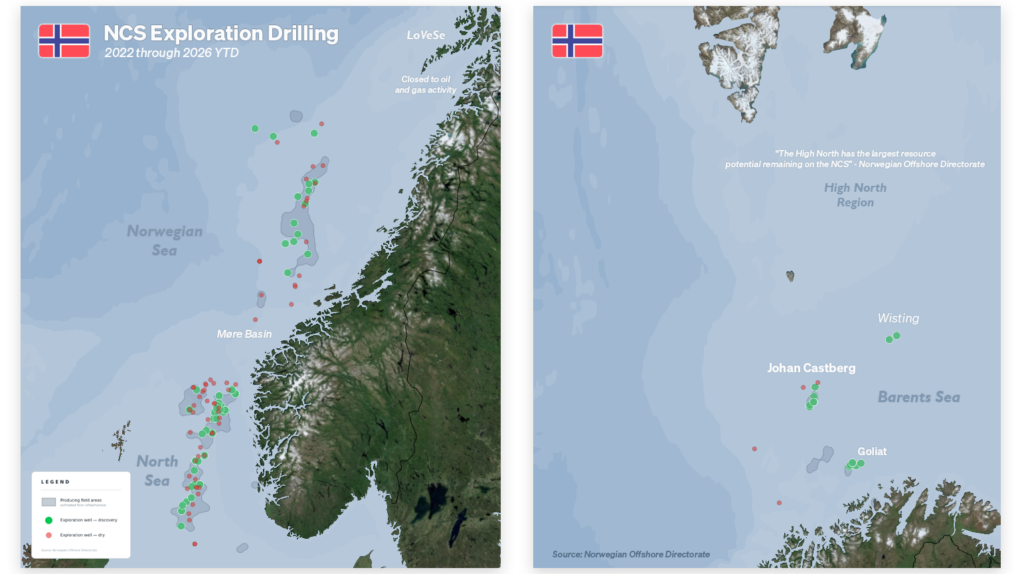
Barents Sea
“The High North (Barents Sea) has the largest remaining resource potential on the Norwegian shelf” – Norwegian Offshore Directorate. However, the High North region has not been opened for oil and gas licensing, although the region is estimated by the NOD to contain approximately 54% of the Barents Sea’s undiscovered resources.
The southern Barents Sea is open to oil and gas activity, with Equinor’s Johan Castberg producing first oil in June 2025 and Wisting, smaller in scale, the next probable greenfield FID in 2027-2028. However, there are no further apparent greenfield projects in the southern portion of the Barents Sea. The northern Barents Sea region, by contrast, remains unopened for licensing. This is a genuinely Arctic environment surrounding Svalbard, a higher-latitude, less-explored frontier that Norway has yet to open to industry.
The European Union supports a moratorium on new Arctic drilling on environmental grounds. But at the ONS conference in Stavanger in late August, Norway’s Energy Minister Terje Aasland pushed back, telling Reuters that if Norway is to remain a long-term supplier of oil and gas to Europe, then the Arctic must be part of that discussion — likely a pointed reference to the northern region of the Barents Sea, the still-unopened “High North” acreage.
Unlike the North Sea and Norwegian Sea, the Barents Sea shares a maritime border with Russia — a proximity that could demand greater military presence to protect production if the region’s importance to European energy grows. It also remains a remote area with limited existing infrastructure.
LoVeSe: The Lofoten, Vesterålen and Senja areas (collectively “LoVeSe”) remain closed to oil and gas licensing. In 2010, the Norwegian Offshore Directorate estimated 1.1B boe of recoverable resources in LoVeSe. However, Norway’s Institute of Marine Research has cited the region’s importance to national fisheries and its vulnerability to oil spills as grounds for keeping it closed. Because fisheries are essentially a perpetual resource, while oil and gas fields typically have finite lives of 30–50 years, the net present value of the fishery could arguably exceed that of the hydrocarbon field over time. However, the prospect of oil and gas activities and fisheries safely co-existing is certainly within the realm of possibility.
For now, LoVeSe appears off the table. Any alliance interest here would be a multi-year, politically contingent bet rather than a near-term drilling target.
Technology and Omega Alfa (example): Beyond acreage in genuinely new frontier basins, technology itself is reopening ground long written off as fully explored. Aker BP’s August 2025 Omega Alfa discovery is an example, with an estimated 96–134 million boe recoverable within tieback distance of existing Yggdrasil infrastructure. The North Sea play Omega Alfa sits in was considered mature, its traditional exploration window effectively closed, because the thin oil columns there had long been judged too difficult to prove commercially.
Using the Deepsea Stavanger semisubmersible rig, operator Aker BP drilled long horizontal, multi-branch wellbores with up to seven tens of kilometers of total reservoir exposure — far beyond a typical exploration well — while advanced geosteering and real-time data kept the wellbore within thin, high-quality reservoir zones over that entire distance. The result achieved a technology-driven discovery in a basin many had assumed had nothing left to give.
Closing
The easy oil developments are gone. What remains in Norway demands overcoming harder challenges: seeing through volcanic rock in Møre, operating safely in the Arctic High North, coexisting with the country’s fisheries, and economically producing from previously commercially challenging geologies such as tight reservoirs and thin, hard-to-produce targets requiring advanced geosteering, such as Omega Alfa. Pooling Equinor, Aker BP and Vår Energi’s data, capital, and technical experience is a logical response to these challenges.
Norway’s new strategic exploration alliance improves the risk profile of frontier exploration on two fronts: lowering development costs through design simplification and standardization, as well as improving exploration success probabilities by pooling resources and expertise.


Comments (0)
Log in to leave a comment
Sign in