


$300M, 2 years, ~$380k dayrate ex mob fee on ONGC’s Transocean KG2 drillship award is a part of India’s Samudra Manthan energy security program, an ambitious offshore exploration policy to reduce energy import dependence.
Modi’s program is heavily deepwater, >100m water depth.
India’s Krishna-Godavari Basin has deepwater production from Reliance (KG-D6) and ONGC (KG-98/2) with further potential in deeper water depths. The other exploration basins are more play-opening types: Andaman Sea, Cauvery and Mahanadi are all more prospective. The Andaman Sea has had most exploration thus far, although is >1,000 km from India’s east coast shore.
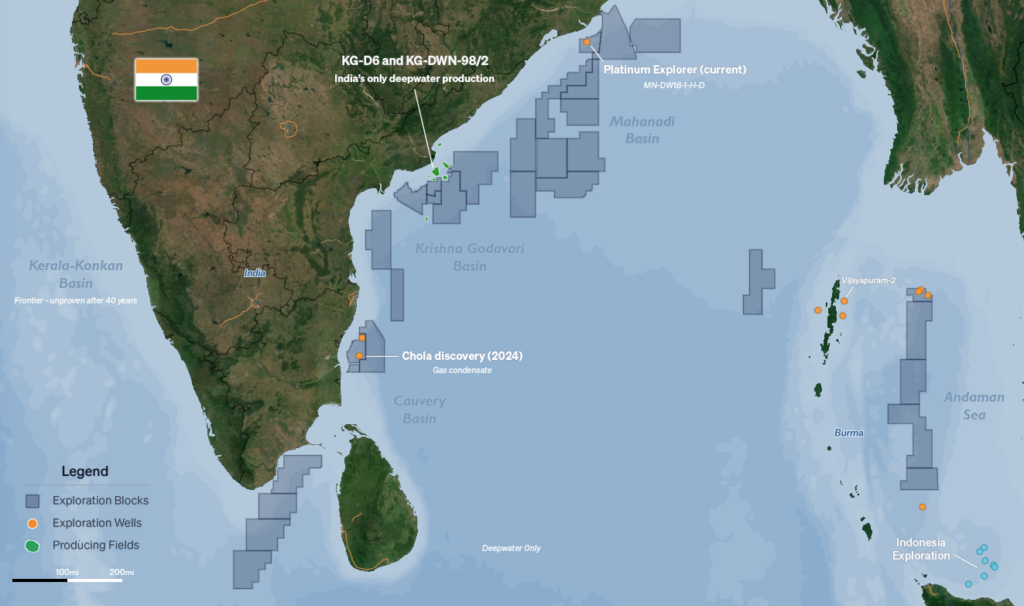
While India hasn’t disclosed much detail from recent Andaman Sea deepwater wells, Mubadala and Harbour have had success on the Indonesia side with large, quality gas discoveries in 2022-2024, most notably Layaran with estimated ~6 Tcf of gas in-place. In 2024, ONGC’s Chola well was reported as a successful gas condensate discovery. The Mahanadi Basin is having its first exploration well drilled right now, by the Platinum Explorer drillship beginning a campaign this summer.
It’s early in India’s exploration program. The KG2 drillship award was a part of an original tender of up to 5 rigs, an optimistic case upside that was pared back to “1 or more”, and while more will likely be needed, Samudra Manthan does not have a blank check; there are limits to how far current funding stretches.
Separately, India’s other NOC, Oil India, will likely need to contract a drillship or two for its participation in the national program. India is a growing floating rig (and OSV) market, but timing and project slippage are risks to monitor.
India’s exploration push is seeking both oil and gas, though early discoveries thus far have skewed gas-heavy, based on public info. Still early, but gas discoveries could prove as valuable given India’s rising LNG import dependence. A variable to follow is proximity to shore: the closer a gas discovery sits to the coast, the easier it is to integrate into India’s onshore economy, and the sooner India can build infrastructure suited to its own potential domestic reserves.


Comments (0)
Log in to leave a comment
Sign in