


Why this matters: Transocean secured a higher-than-expected dayrate in Brazil on a short-term BP exploration and appraisal program, rather than committing to longer-duration Petrobras tenders at potentially lower pricing. While Brazilian rig demand remains dominated by Petrobras, success on this campaign could unlock follow-on demand from BP and Equinor.

Transocean’s Deepwater Mykonos secured a 302-day contract with BP offshore Brazil at an estimated ~$397k/day, commencing 3Q26. Mykonos is a competitive 6G drillship in Brazil and has spent most of its life working for Petrobras, most recently in the Santos Basin. By comparison, in mid-December Valaris announced an ~800-day contract for its DS-8 (7G) drillship with Shell on the Orca (formerly Gato do Mato) development, starting 1Q27 at an estimated ~$375k/day. While DS-8 secured materially more term, Mykonos achieved a higher headline dayrate.
The BP award is also notable as Mykonos’ first job with an operator other than Petrobras since its 2012 delivery. Given its recent operating history in the Santos Basin, Mykonos was a natural candidate for Petrobras’ open multi-year tenders. However, those tenders appear highly competitive, with regional contractors prioritizing utilization over price, limiting dayrate upside potential into 2027–2028.
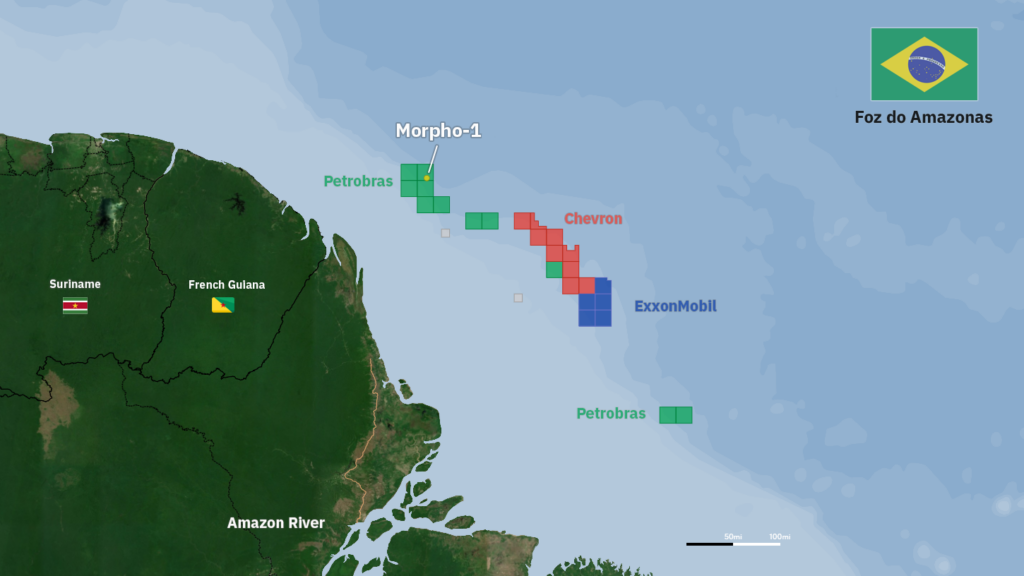
Operationally, the BP program is expected to include appraisal drilling at the Bumerangue discovery, which BP has described as its “largest discovery in 25 years“. Given the ~300-day duration, the campaign is also likely to test BP’s adjacent Tupinambá block. The acreage sits alongside Equinor-held blocks, including S-M-1378, and Equinor recently expanded its Santos Basin footprint by winning S-M-1617 in the June 2025 licensing round, prior to the Bumerangue announcement.
If BP’s appraisal results are constructive, Transocean could see follow-on exploration demand from Equinor, which already operates in Brazil and is advancing Bacalhau (first oil achieved) alongside the Raia gas development. Shell also holds exploration exposure further south in Brazil’s Pelotas Basin, underscoring growing IOC interest beyond the core pre-salt. While Bumerangue carries known CO₂ content risks, these are familiar challenges in the Santos Basin, with commercial outcomes driven by manageability.
The shorter duration of the BP program preserves Mykonos’ availability into late-2Q to 3Q27, a period that could align with firmer drillship utilization and a broader set of IOC opportunities in Brazil, alongside future Petrobras tenders.
At minimum, Transocean gains insight into the commercial potential and longer-term rig demand of an emerging Santos Basin sub-trend—an important consideration as Petrobras has signaled a potential reduction in its contracted rig count toward 2030. At best, Mykonos could be positioned for longer-cycle, IOC-led development work if activity in the area builds. The risk, as always, is that Bumerangue’s commercial momentum fails to materialize, but that uncertainty is inherent to deepwater contract drilling and a risk worth taking given the discovery’s scale, BP’s renewed focus on E&P, and the involvement of a well-capitalized IOC capable of funding development


Comments (0)
Log in to leave a comment
Sign in