


Shell and QatarEnergy have announced a light oil discovery at Merlin-1X in PEL 39 offshore Namibia, drilled by Northern Ocean’s Deepsea Mira beginning in April 2026. Shell characterized the discovery as “good reservoir quality with light oil and limited associated gas, compared to prior results within the license.” PEL 39 is operated by Shell (45%), alongside QatarEnergy (45%) and NAMCOR (10%).
The Merlin-1X discovery is welcome news after Shell’s $400MM write-down in early 2025 raised serious questions about the commercial viability of its prior discoveries in PEL 39. Shell’s prior exploration and appraisal campaigns beginning as early as late 2021 included high-profile Graff and Jonker discoveries, but subsequent appraisal revealed reservoir permeability issues and elevated associated gas, concerns that ultimately drove the write-down.
Along with TotalEnergies, Shell was one of the earliest deepwater explorers in Namibia’s Orange Basin. Since Shell concluded its original exploration campaign in early 2024, major discoveries were made in the basin including Galp Energia’s Mopane in PEL 83 and Rhino Resources and Azule Energy’s Capricornus in PEL 85. Along with various other exploration and appraisal activities, the industry has materially advanced its understanding of the basin’s reservoir characteristics and hydrocarbon potential since early 2024. Shell’s successful return to PEL 39 appears to have benefited from two years of basin-wide appraisal data it did not have during its original campaign.
While the Orange Basin is a very large hydrocarbon resource, a meaningful amount of associated gas has been found along with the oil in various wells, although Rhino Resources and Azule Energy’s Capricornus-1X light 37° API oil discovery was described as having “limited associated gas” which reduces development challenges, all else equal. Likely not coincidentally, Shell and QatarEnergy’s first well (Merlin-1X) after learning from others’ exploration and appraisal activity was only 38 km to the southwest of Capricornus, and the Merlin-1X light oil discovery also exhibited limited associated gas.
As Shell’s Graff and Jonker experience demonstrated, it is too early to declare Merlin a commercial discovery. Positively, the Saipem 12000 drillship has been drilling the Capricornus-1A appraisal well since early May 2026, which should provide more detail about the reservoir and potential commerciality of the discovery. While 38 km away, learnings from this appraisal well could provide applicable read-through to the new Merlin-1X discovery.
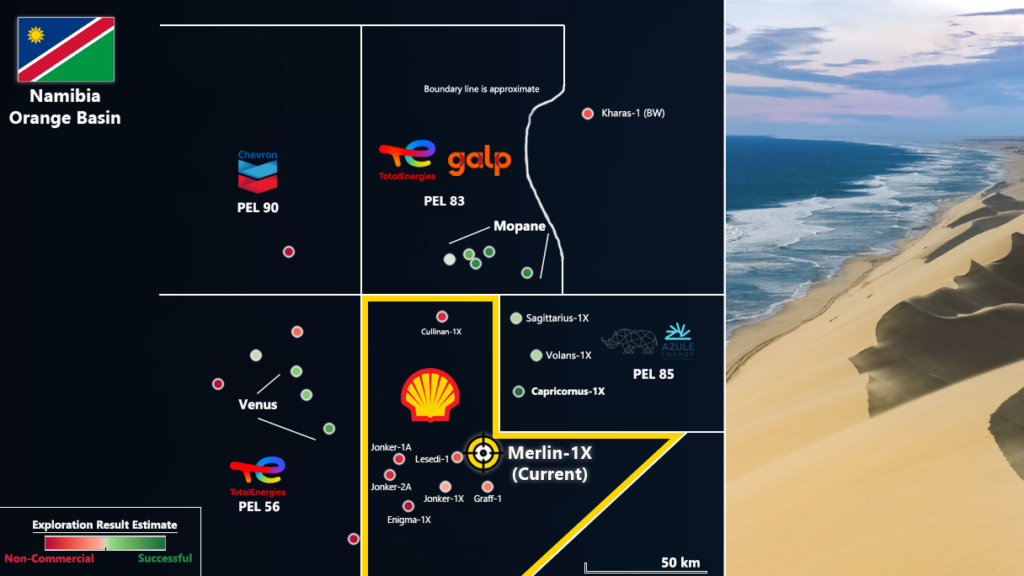
Shell’s prior Graff, Jonker and Lesedi discoveries sit 14 km, 20 km and 9 km from Merlin-1X respectively — close enough that a successful appraisal could potentially support a hub-style development incorporating Shell’s prior discoveries which do not support a development on their own. While Shell’s Deepsea Mira contract with Northern Ocean includes one optional well, Shell’s public release on the Merlin discovery states “further drilling later in 2026 is under consideration as a part of a broader exploratory appraisal program.”
Elsewhere in Namibia, TotalEnergies is anticipated to take FID on the Venus development in PEL 56 as soon as July 2026. The French oil major has had a tender outstanding for two rigs to support potential development drilling for Venus which it originally discovered in February 2022. Further, TotalEnergies is expected to launch a two-to-three well exploration and appraisal campaign in PEL 83 following its December 2025 farm-in agreement with Galp, under which it acquired a 40% operated interest. PEL 83 is viewed as potentially more capital-efficient than Venus, although further appraisal is needed. Additionally, Chevron is anticipated to return to Namibia for more exploration drilling after its dry well Kapana-1X in PEL 90, which may include another well in PEL 90 and PEL 82 to the north in the Walvis Basin.


Comments (0)
Log in to leave a comment
Sign in