


The U.S. Bureau of Ocean Energy Management (BOEM) publishes estimates of undiscovered technically recoverable oil and gas resources on the Outer Continental Shelf (OCS) every five years. Its March 2026 assessment estimates a mean of 65.8 billion barrels of oil and 218.4 Tcf of natural gas across the Alaska, Gulf of America, Pacific and Atlantic OCS regions, or approximately 104.7 billion BOE in aggregate. Alaska accounts for the largest share at 45.9 billion BOE, followed by the Gulf of America at 35.0 billion BOE, the Pacific OCS at 13.2 billion BOE and the Atlantic OCS at 10.6 billion BOE.
The Gulf of America produced 1.8–2.0 million bpd in 2025, is oil-weighted, and faces the least political resistance to development among the four OCS regions. The Wilcox Slope holds the largest share of remaining undiscovered resources, a play already proven by Great White, Jack/St. Malo, Buckskin, and Anchor. The Miocene trend also carries meaningful undiscovered resource potential, as evidenced by Talos Energy’s Daenerys discovery in August 2025. While the Gulf of America is a maturing basin, oil majors remain active across multiple play types — Shell’s December 2025 Nashville discovery in the Jurassic Norphlet being the most recent example.
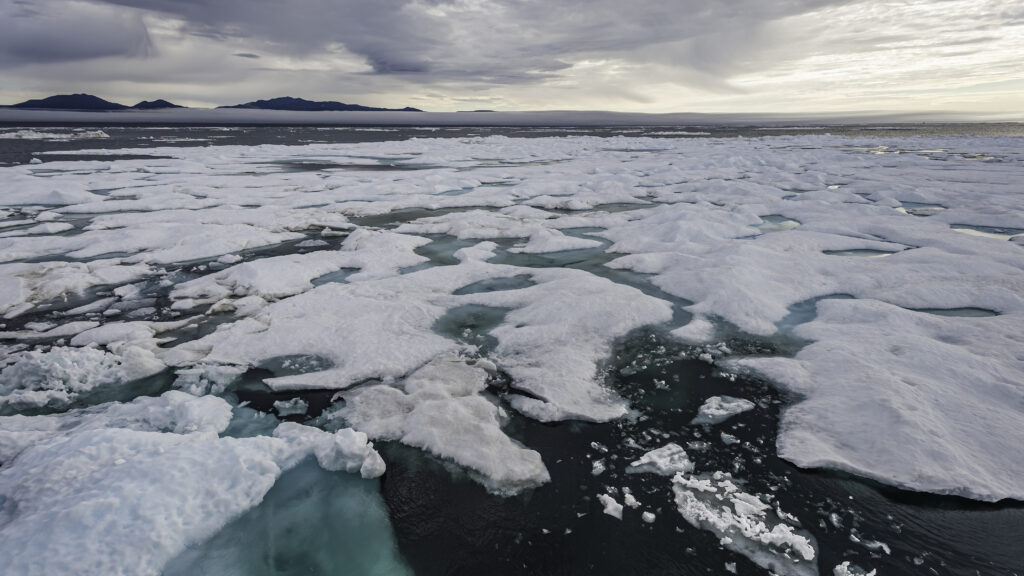
Approximately 3,500 miles northwest of the Gulf of America, Alaska’s Chukchi and Beaufort Seas account for the largest share of BOEM’s estimated undiscovered OCS resources, yet the region’s absent infrastructure and extreme arctic conditions make it among the highest-cost frontier areas in the world. Development interest has declined materially after low-cost Permian supply began weighing on global oil prices.
The Chukchi Sea’s last serious test of commercial appetite predates the shale era. BOEM’s February 2008 Lease Sale 193 generated $2.66 billion in winning bids — Shell committed $2.1 billion and ConocoPhillips $506 million — at a moment when >$100/bbl prices and pre-shale supply concerns made Arctic exploration appear economically compelling. After prices collapsed in late 2014 and exploration results disappointed, Shell took a $2.6 billion non-cash impairment on its Alaska program in 2015 and abandoned the region.
The Trump administration moved in November 2025 to open Beaufort Sea leasing as early as 2026, but the commercial signal from Alaska is unambiguous: a recent Cook Inlet lease sale drew zero bids. With capital discipline a stated priority across the majors and lower-cost deepwater opportunities available elsewhere, meaningful exploration activity in either Alaska offshore region seems unlikely regardless of the political environment.
California’s offshore resources are concentrated in the high-quality Santa Barbara-Ventura Basin and would likely be economically attractive to E&P companies, however the state’s political opposition to offshore development is entrenched and unlikely to shift in any meaningful timeframe.
The Atlantic OCS is a true frontier region, lacking modern 3D seismic and carrying the uncertainty that comes with it. Its conjugate margin aligns with Mauritania and Senegal, where significant deepwater gas discoveries have been made, including the Greater Tortue Ahmeyim LNG development — though that analogy has limits given the different fiscal and infrastructure context. The Atlantic OCS is assessed as predominantly gas-bearing, which reduces its near-term commercial appeal given abundant domestic supply from Appalachian shale. Political headwinds compound the challenge: coastal-state Republican opposition has proven a durable constraint on Atlantic leasing, and that dynamic is unlikely to change soon.
Across all four offshore regions, the Gulf of America stands out as the only area where resource scale, development economics, infrastructure and political environment align. Alaska holds the largest estimated resource base but remains commercially stranded for the foreseeable future. California and the Atlantic face political constraints that are structural rather than cyclical. For oil majors and independent E&P companies allocating deepwater capital, the Gulf of America will be the most relevant, particularly as 20,000 psi completion technology unlocks the resource base at commercial scale using 8G drillships. Chevron’s Anchor and Beacon’s Shenandoah have already demonstrated the technology in production; bp’s Kaskida, Tiber-Guadalupe and Shell’s Sparta represent the next wave, collectively committing more than $15 billion to a resource that was commercially unviable without completion technology that did not exist a decade ago. BOEM’s 2026 assessment suggests the resource runway remains long.


Comments (0)
Log in to leave a comment
Sign in